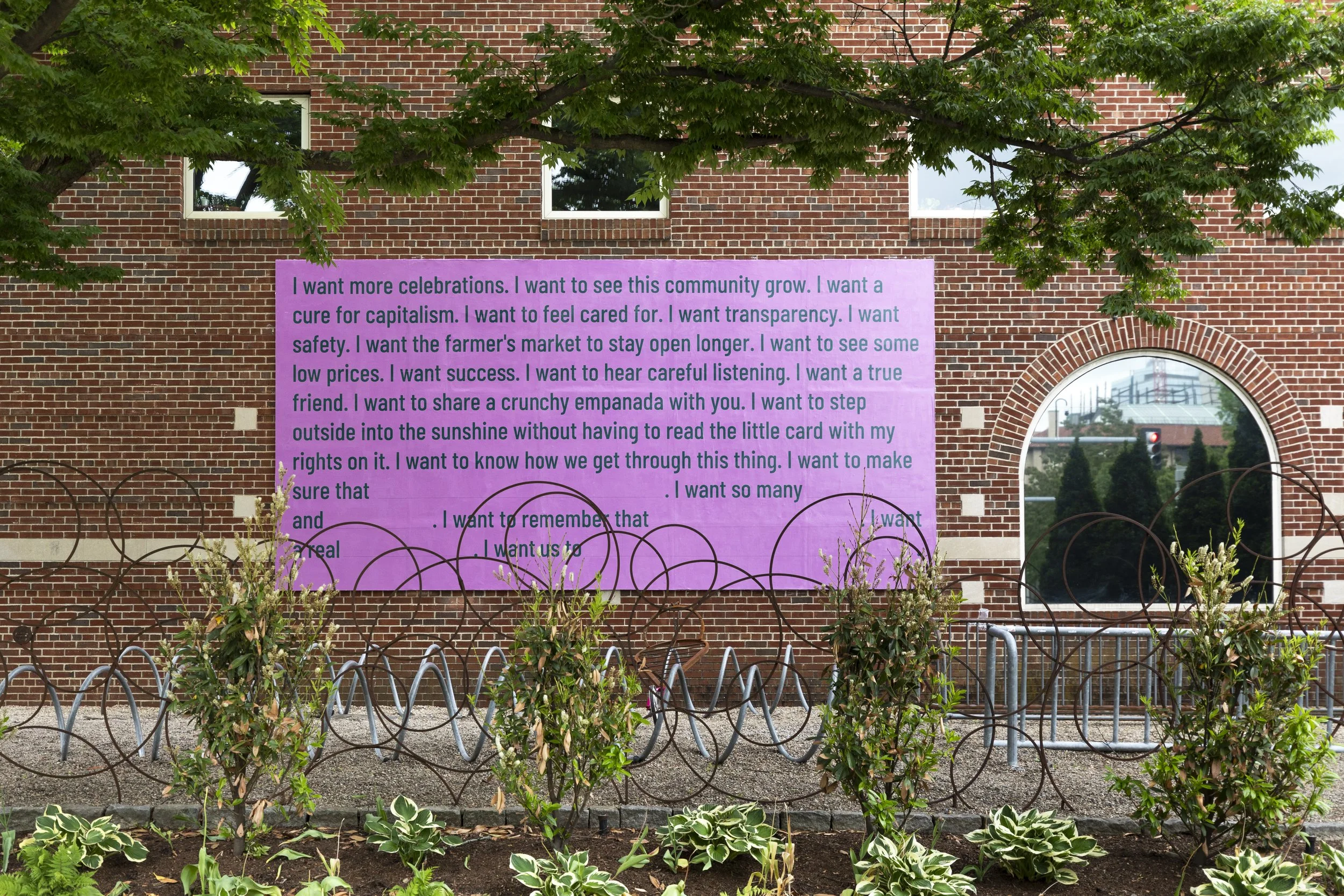
Situated on the facade of the School of the Museum of Fine Arts at Tufts, “I want more celebrations” was created during the Boston Public Art Triennial as part of a workshop with East Boston youth. The work points to "I want a president, " 1992—shown on this same facade in 2018—in which a typed letter reads “I want a dyke for president” and continues on to describe a political candidate who has suffered illness, poverty, and loss.
In a workshop co-facilitated with Paola Ruiz, youth participants at Maverick Landing Community Services in East Boston relayed the need for joy, safety, affordable food, and friendship. Their perspectives pair with an invitation for the public to fill in their own hopes and desires.
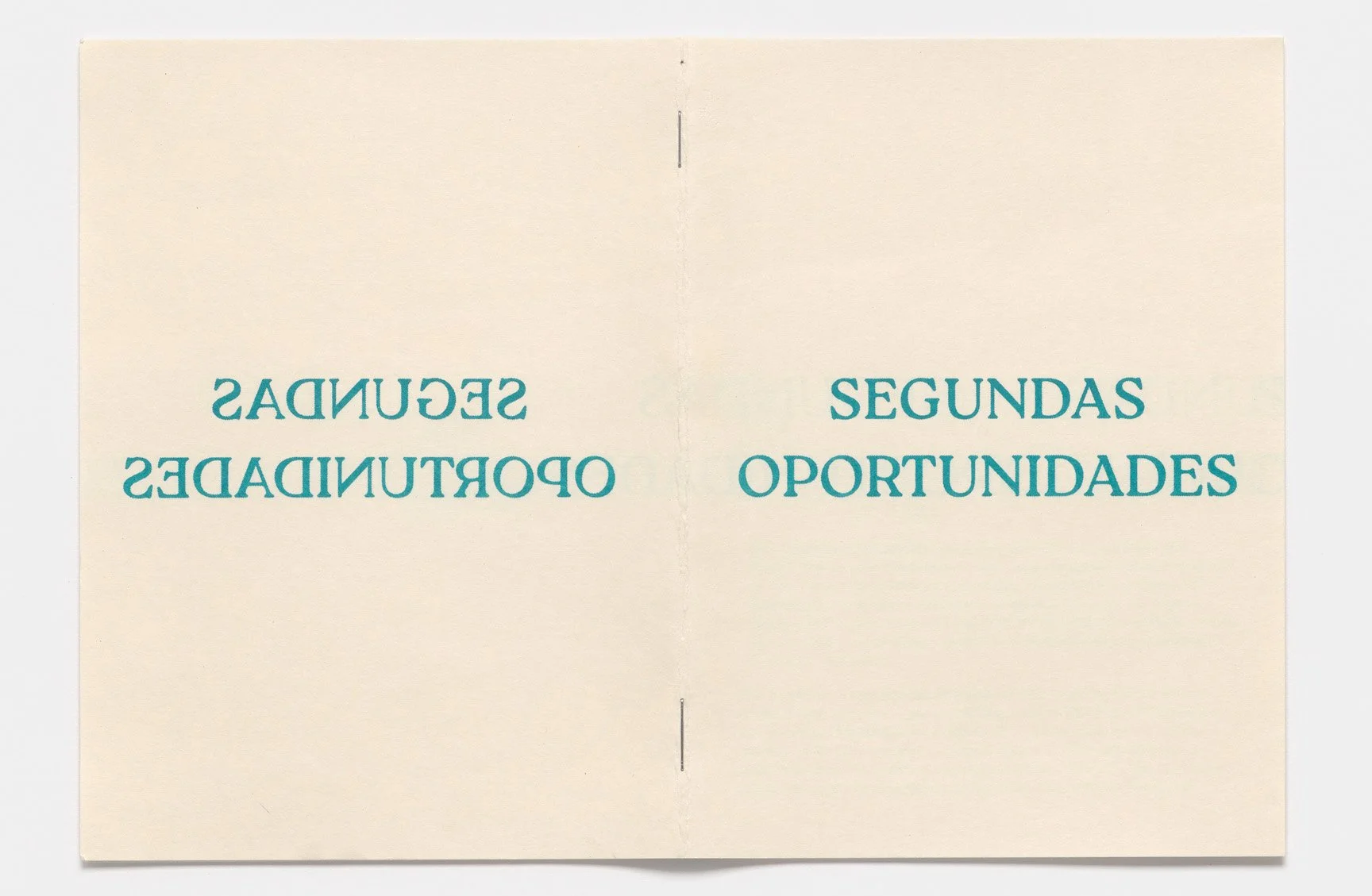
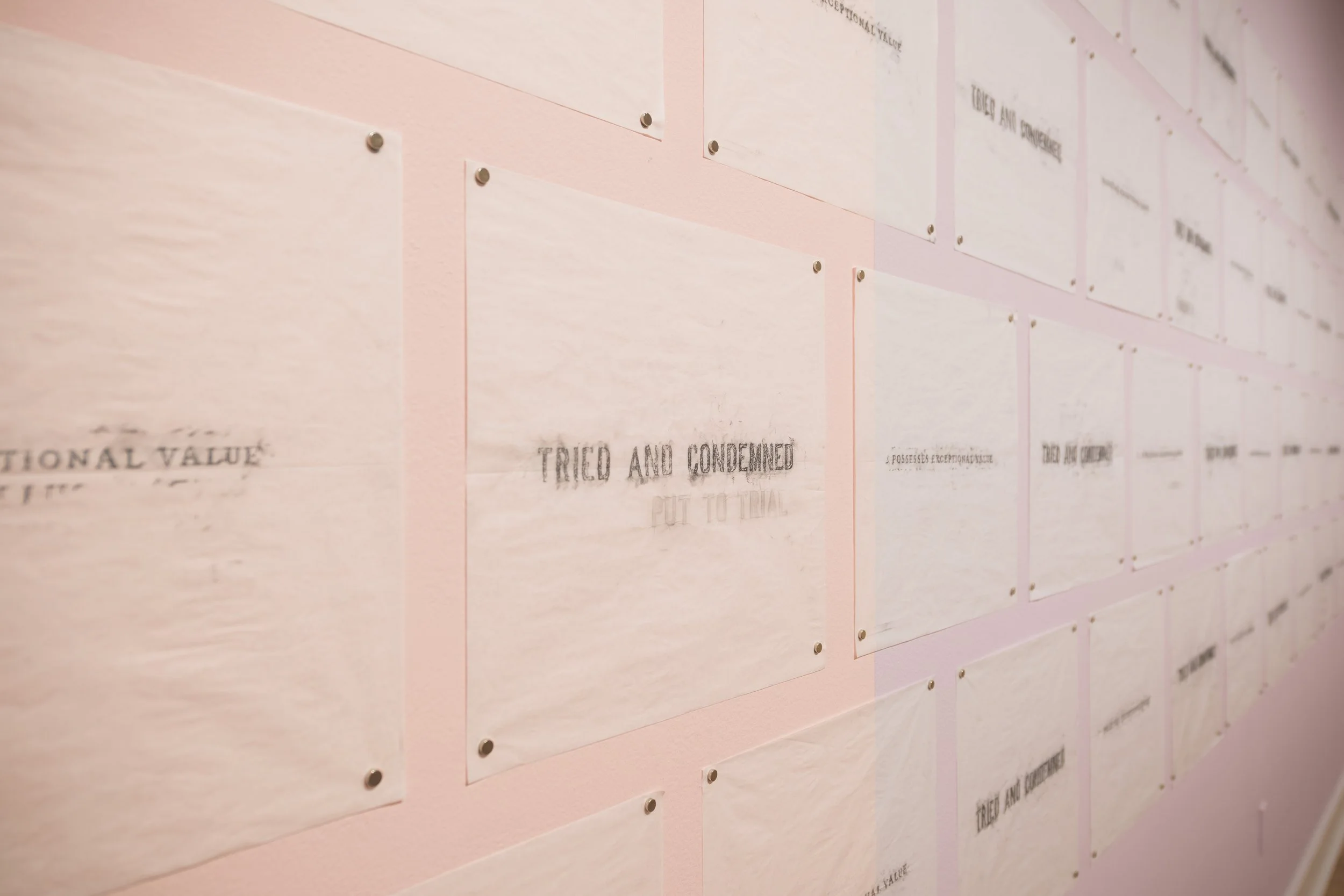
Originally paired with a series of drawings that referenced the jury trial system on display at the Wagner Foundation in Cambridge, Massachusetts, the title comes from “Pero creo que la vida ésta basada en segundas oportunidades,” translating to “But I feel that life is made from second chances,” excerpted from a character letter written by a defendant's loved one for leniency in sentencing, which Sosa had access to in his access in his previous career as a court interpreter. Conceived with the potential for circulation in mind, Sosa created an inside-out relationship from the gallery to the street and the ways in which perceptions of guilt and redemption are socially conditioned.
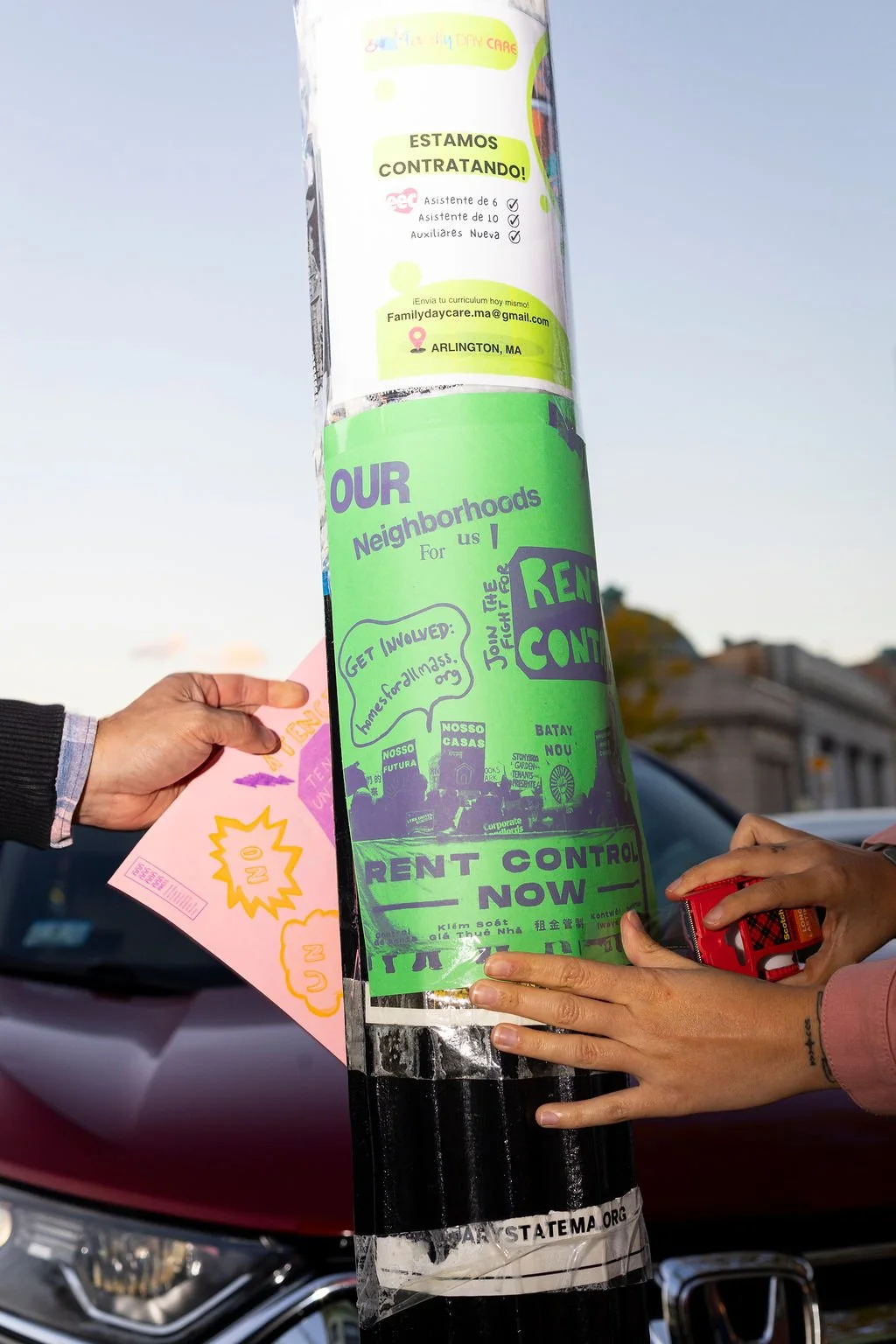
ñ press is a community print studio and publishing platform focused on connection, activism, and education. Launched by artist Gabriel Sosa as part of the inaugural Boston Public Art Triennial, ñ press conceptualizes print as public art, embracing its capacity to circulate in the public space while providing opportunities for shared learning.
Through screenprinting and risography, ñ press produces posters, zines, pamphlets, and books that prioritize care, solidarity, and social advocacy. In addition to open invitations to the public, ñ press engages in specialized print initiatives with various groups, organizations, and fellow artists.
ñ press includes artists Colomba Klenner, Riley McLaughlin, Iz Hall, Nate Bourget, and Gabriel Sosa, and lives at Maverick Landing Community Services (MLCS), a community health nonprofit in East Boston.
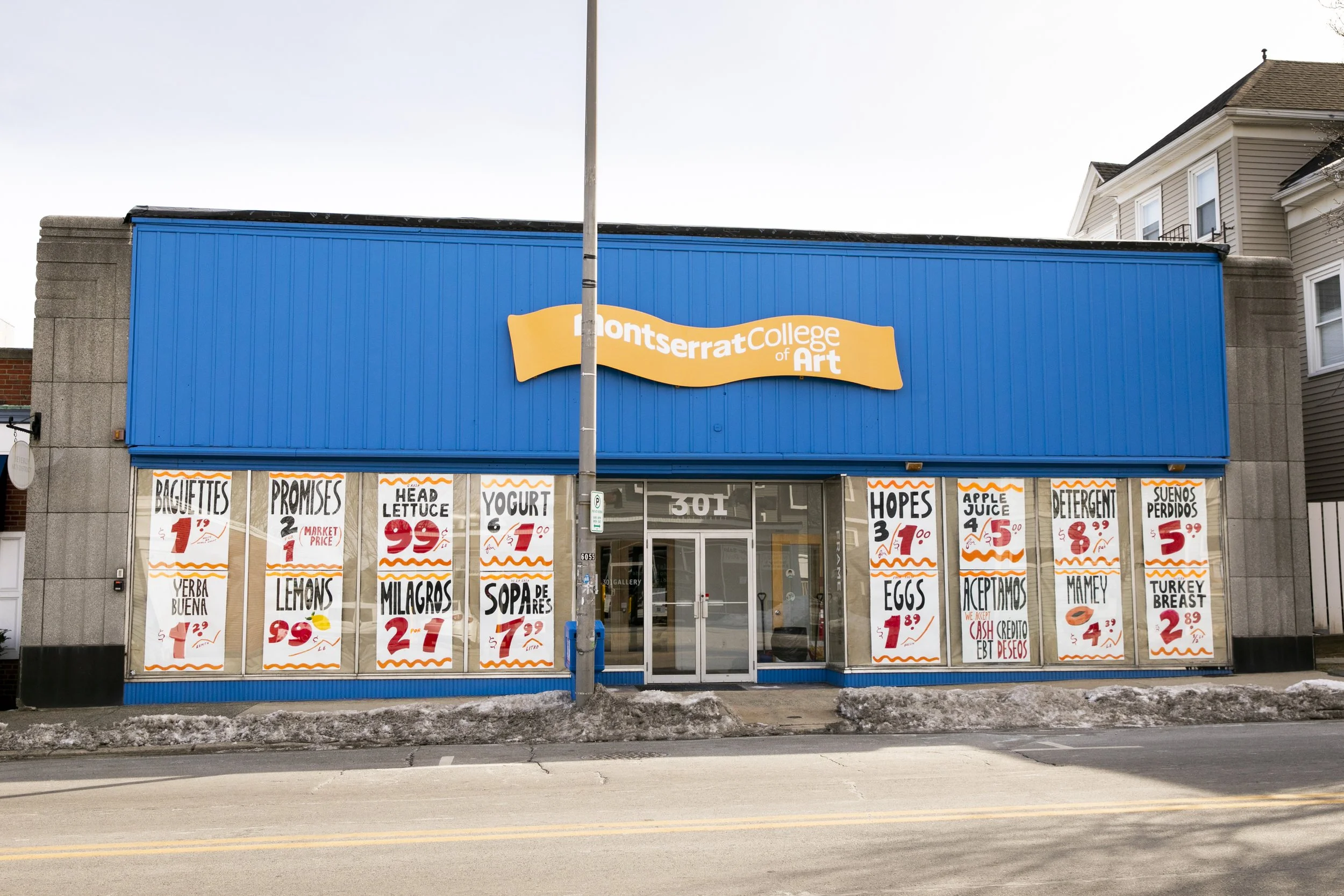
La bodega de mis sueños is a fictitious business created on the facade of the Fitchburg Art Museum in Fitchburg, Massachusetts that considers how corner stores can serve as integral fixtures in many Latin communities in the U.S. where entrepreneurialism, reminders of home, and community care can thrive while also pointing to the growing Latin community in Fitchburg itself. Simultaneously, the work revives the museum's architectural history by referencing the building's past as commercial storefront space until the early 1980s, which one included a shoe store and barbershop. La bodega de mis sueños serves as a repository for the hopes and dreams of the neighboring community, providing a working phone number and an oral archive of the messages shared.
2022
Site-specific installation at Montserrat College of Art, Beverly, Massachusetts
Amidst the oversized hand-painted announcements for laundry detergent, apple juice, and sopa de res, a handful of surprises are also on sale, evoking questions of subversion, gentrification, and the shortcomings of the American Dream. Situated on an urban college campus with a laundromat directly across the street, the installation also points to the structures of monetary exchange that characterize American public space. This work served as a precursor to La bodega de mis sueños, a semi-permanent installation in Fitchburg, Massachusetts.
The title of this exhibition at Fitchburg Art Museum comes from a legal exercise in which participants argue the definition of a “vehicle” as prohibited in a public space. Would a skateboard, stroller, or wheelchair be considered a vehicle? Are there ever exceptions to the rule, such as an ambulance that needs totransport an injured patient? Legal language is meant to express with efficiency and clarity, but ambiguity is frequently present—and sometimes welcomed. In the legal system, words wield power. They direct case outcomes and expose skewed power dynamics between prosecution and defense.
Language is inherently imperfect. This notion forms the basis of this work, which is largely influenced by Sosa’s twelve years of experience as a Spanish-language interpreter in the Massachusetts Trial Court. This work explores the ambiguity of language, the power dynamics embedded in legal jargon, and the consequences of phrasing. No Vehicles in the Park features work that urges us to consider the contradictions in the American legal system, the impact of past tradition on the present, and the openness of interpretation.
2021
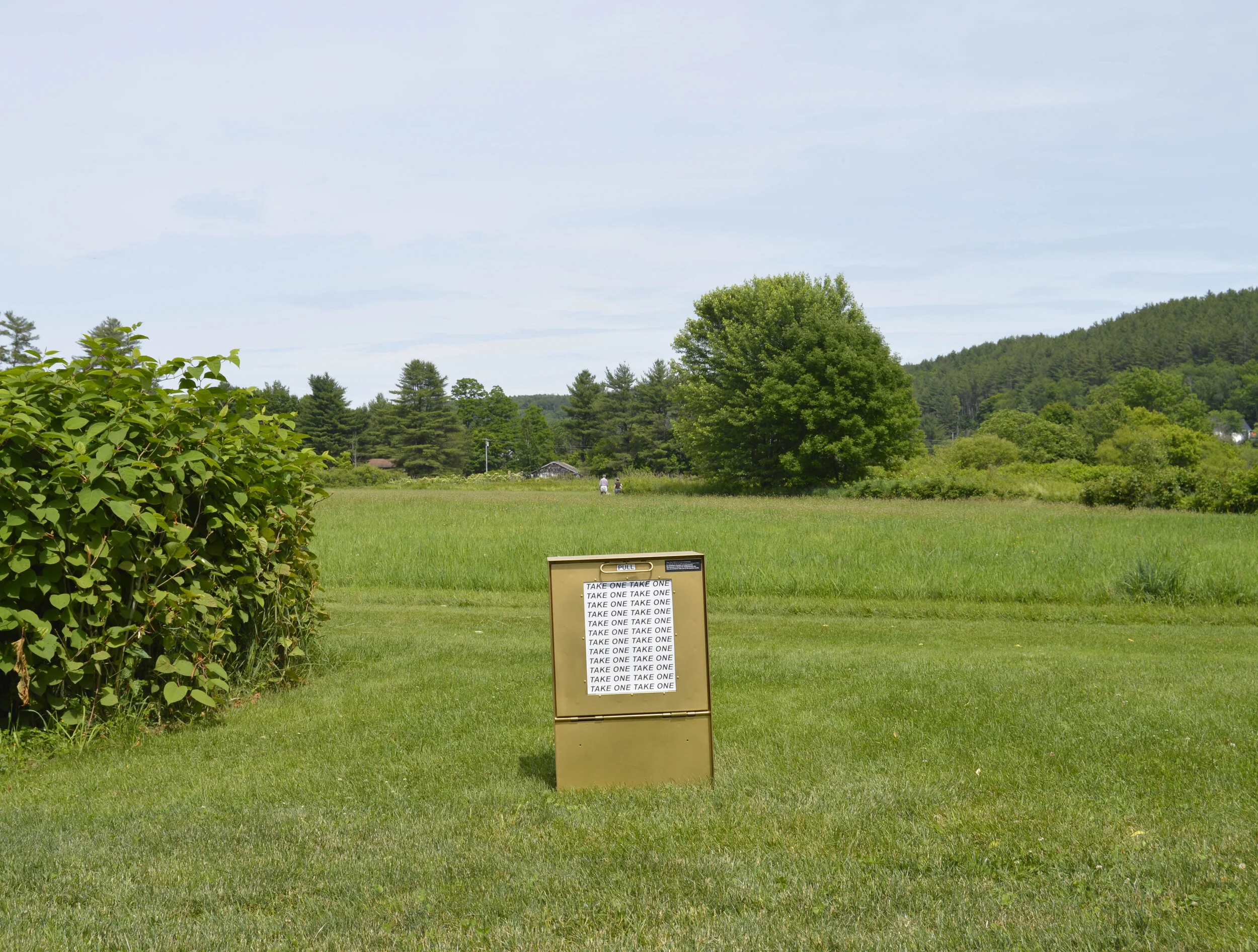
Created specifically for Exposed at The Current in Stowe, Vermont, these 3 gold-colored newspaper distribution boxes seek to subvert language found in the public space through their placement in different sites around Stowe including Main Street and the Rec Path. Each box is filled with a stack of posters that feature various questions drawn from criminal court proceedings coupled with statistics about ubiquitousness of guilty pleas in U.S. courts. The questions, posed by judges to defendants, are sourced from pleas in which I have participated as a court-certified Spanish interpreter in Boston. Taking cues from the work of Félix González Torres, the public is welcome to take posters and share them as they wish. By recontextualizing the question and answer dynamic of the courtroom and circulating it into the public space through a container traditionally reserved for commercial purposes, I hope to not only stimulate a dialogue about the reach of the carceral state, but also invite a heightened awareness of the power of the language.
2021
Patience was a site-specific installation created at the Boston Cyberarts Gallery, located at the Green Street MBTA Station in Jamaica Plain, for Message Received, an exhibition curated by Jameson Johnson. Sosa utilizes the train station as a site for examining the notion of waiting as it pertains to the language of activism. Combining Spanish and English text with the aesthetics of commercial spaces in transition, Sosa manipulates the adages “La paciencia es un árbol de raíz dulce pero de frutos podridos” (Patience is a tree with bitter roots that bears sweet fruits) and “Cuando fuiste martillo, no tuviste clemencia. Ahora que eres yunque, ten paciencia” (When you were a hammer you had no mercy, now that you’re an anvil, have some patience) and invites readers to consider the paradoxical necessity and futility of waiting.
2021
Evelyn Rydz and Gabriel Sosa created a series of collaborative, site-specific works on paper for the Brookline Arts Center that explore longing, division, contagion, and the passage of time. In consideration of the Brookline Art Center’s history as a former fire station, Rydz and Sosa used the antagonistic nature of fire and water to emphasize urgency and heightened divides.
Rydz layers together fragments of surface water drawings and photographs from various local rivers and locations across the Atlantic and Pacific in North and South America. Sosa draws from legal proceedings and phrases found in articles and on social media to create jumbles of barely legible texts that float, or sink, among the contours of Rydz’s aquatic imagery. Meanwhile, Rydz layers ripped pieces of paintings with salt water over and under Sosa’s brightly colored smudges and marks.
In their respective art practices, Rydz and Sosa have radically divergent aesthetics and methods of working -the former approaches her work with a patient, almost surgical precision, while the latter works quickly and feverishly. The work of each consumes but reinforces that of the other, reminding us of the division, uncertainty, and hope that mark these times.
2020-21
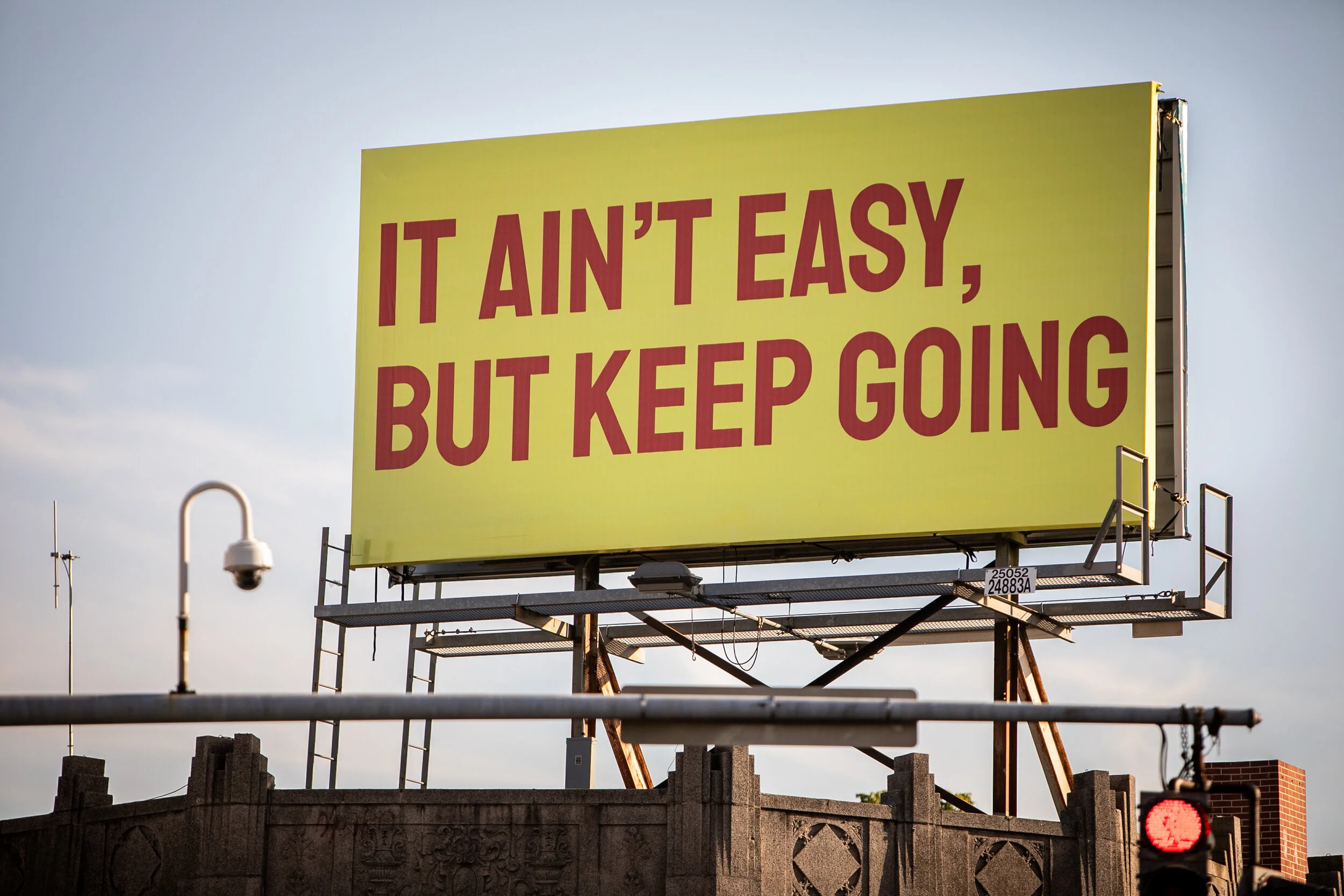
No es fácil/It ain't easy is a bilingual series of nine billboards shown in various Boston neighborhoods from July 2020 through January 2021 in an effort to subvert an iconic consumerist medium to provide comfort and solidarity in the midst of these difficult time. Inspired by the phraseology and bilingualism of my Cuban-American upbringing and the writings of William Carlos Williams, they appeared in areas most impacted by the Covid-19 pandemic, including East Boston, Roxbury, Roslindale, Mattapan, and Dorchester.
These billboards were accompanied by a series of four free, virtual, and bilingual writing workshops held by Gabriel Sosa and artist and writer Sara Rivera. In these workshops, participants would respond to a series of prompts that culminated in a series of postcard designs decided upon collectively by the group. After each session, each participant would receive a pack of the postcards designed by their group, along with stamps, so that they could be shared.
2019
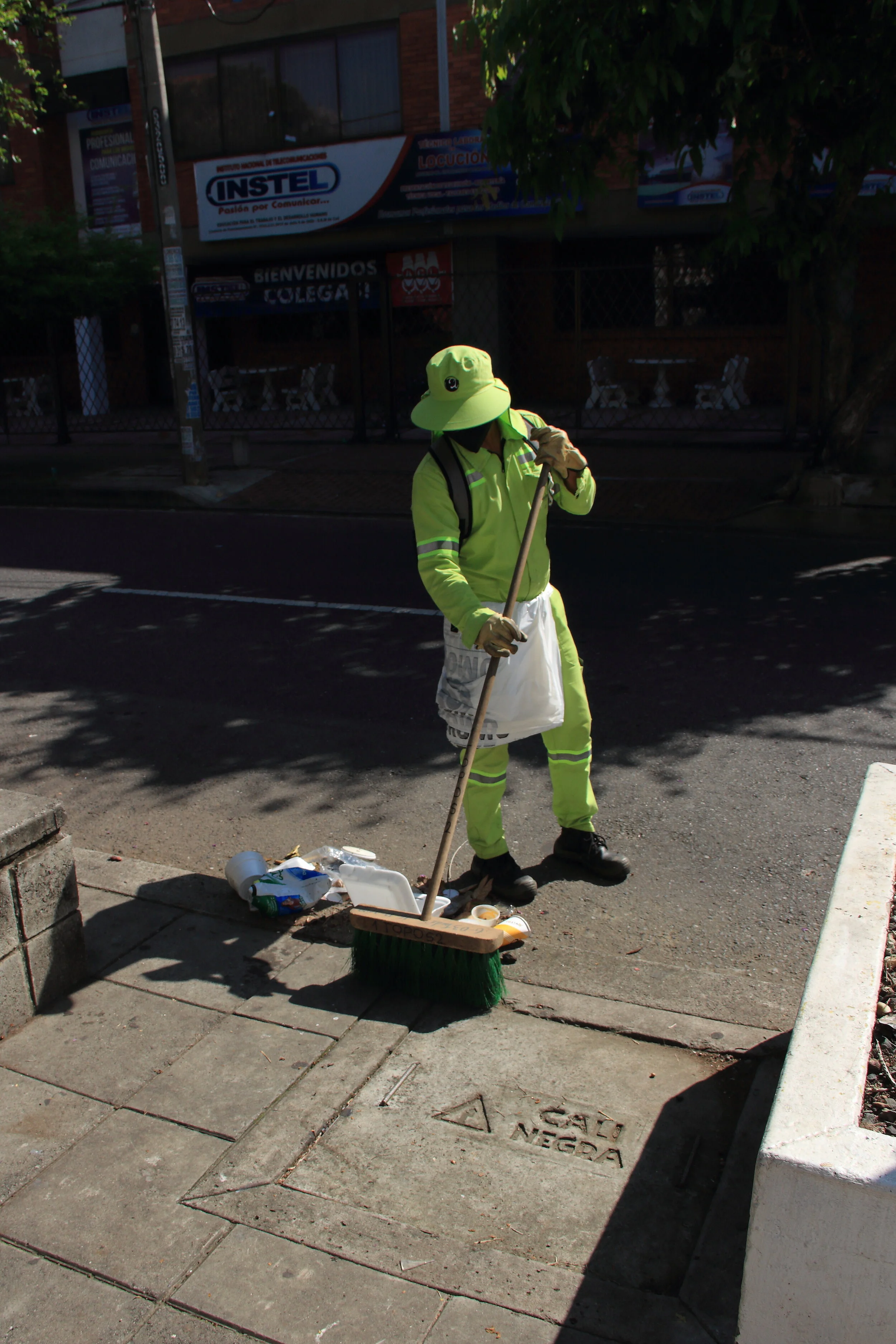
Embedded into the sidewalk and masquerading as an access point to Emcali Energía, the municipal electric company in Cali, this work appropriates the company’s logo and typography to form the words “Cali Negra,” a reference to the local legend behind El Cerro de las Tres Cruces, a hill that overlooks the city.
2019
Site-specific installation, Barrio Granada, Cali, Colombia
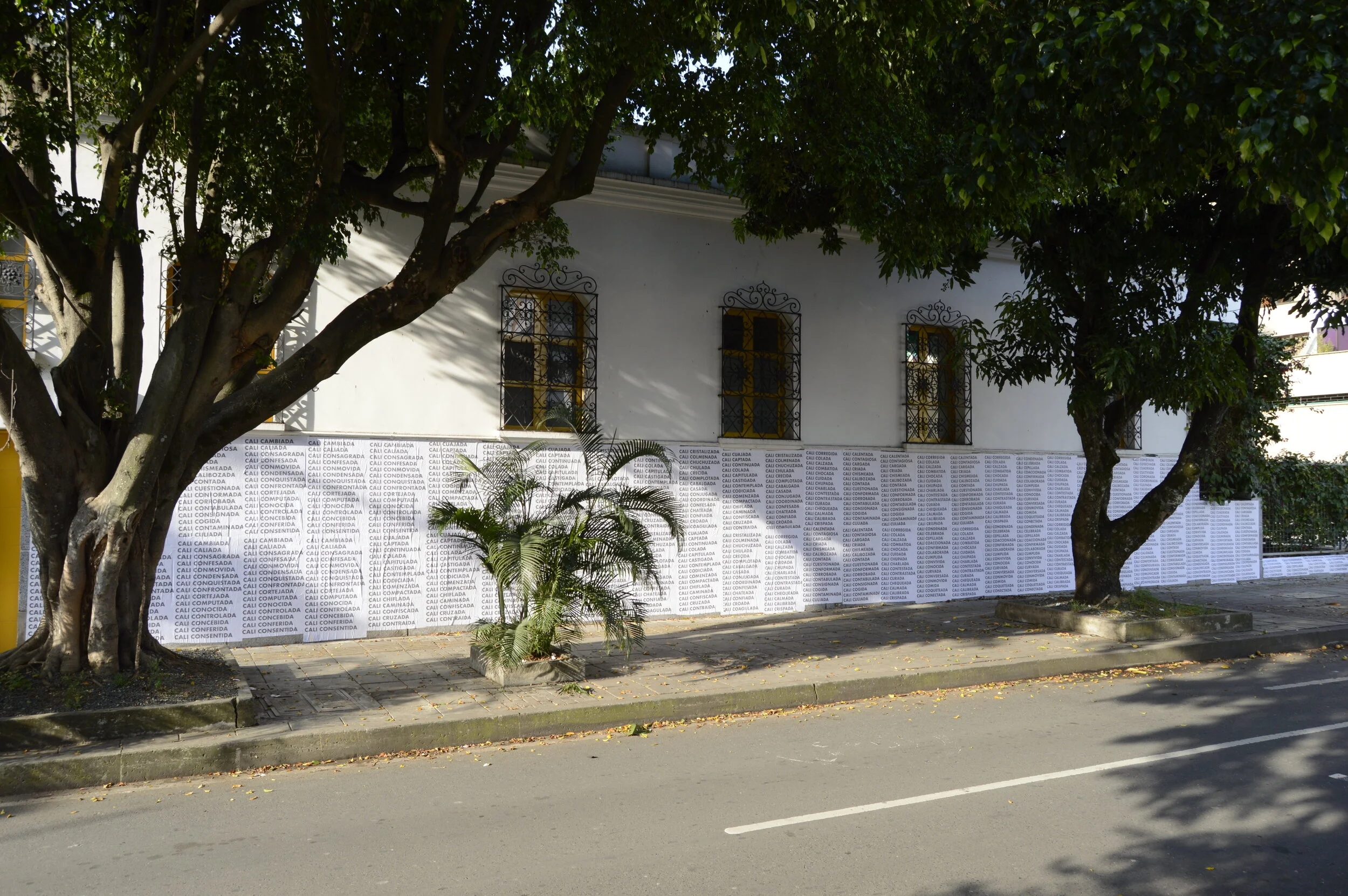
Drawing upon the multiple interpretations of the local stating that “Cali es caliente,” this work compiles adverbs that begin with “C” in a nod to caleño culture that’s both critical and playful.
2019
Taking After Babel by George Steiner, a seminal text on translation theory, as a point of departure, this drawing and text-based installation considered the pitfalls inherent in translation and the false assumptions about interpretative process in the American judicial system.
Let me explain to you what this means was exhibited in two parts at the Medford and Boston sites of the Tufts University Art Galleries, and formed part of Artist’s Response, an ongoing initiative organized by curator Abigail Satinsky that uses creative strategies to respond to social crises through direct action and critical reflection.
The reading area, located in an area of the School of the Museum Arts where students would congregate for meetings or study groups, included a variety of texts that were influential in the installation’s development, including Crook County by Nicole González van Cleve and Is that a fish in your ear? by David Bellos.
The installation was complemented by two participatory workshops held by Sosa at the school - one in a performance course taught by Danielle Abrams and another in a drawing course taught by Ethan Murrow. Each workshop drew heavily on elements of performance and mark-making, respectively, in the court interpreting process and the room for doubt and uncertainty that forms an inseparable part of the translation process.
2018
Do you understand what I’m saying? explores the imperfections and ambiguities inherent in language by presenting questions sourced from local court proceedings that exude a sense of doubt, power, and intimidation. Behind the vinyl, drawings created by hand hint at the more emotional, human events that the questions respond to.
On display in Davis Square in Somerville, Massachusetts in November and December 2018, the installation followed the confirmations of Judge Brett Kavanaugh to the United States Supreme Court.
2017
Three Acts For(giving) was an exhibition curated by Gabriel Sosa and featuring work by Silvi Naçi, Bryana Siobhan, and Danielle Abrams held at Haley House, a bakery and soup kitchen in Roxbury, Massachusetts. In the spirit of Haley House's mission of social justice, the works referenced forgiveness, rebirth, and renewal.
Le queda un minuto (2017) is based on the phone calls made by inmates to their families. Prosecutors often listen to these calls in search of incriminating statements; however, what's discovered is often much more poignant - mundane stories about someone's day and messages of love.
2017
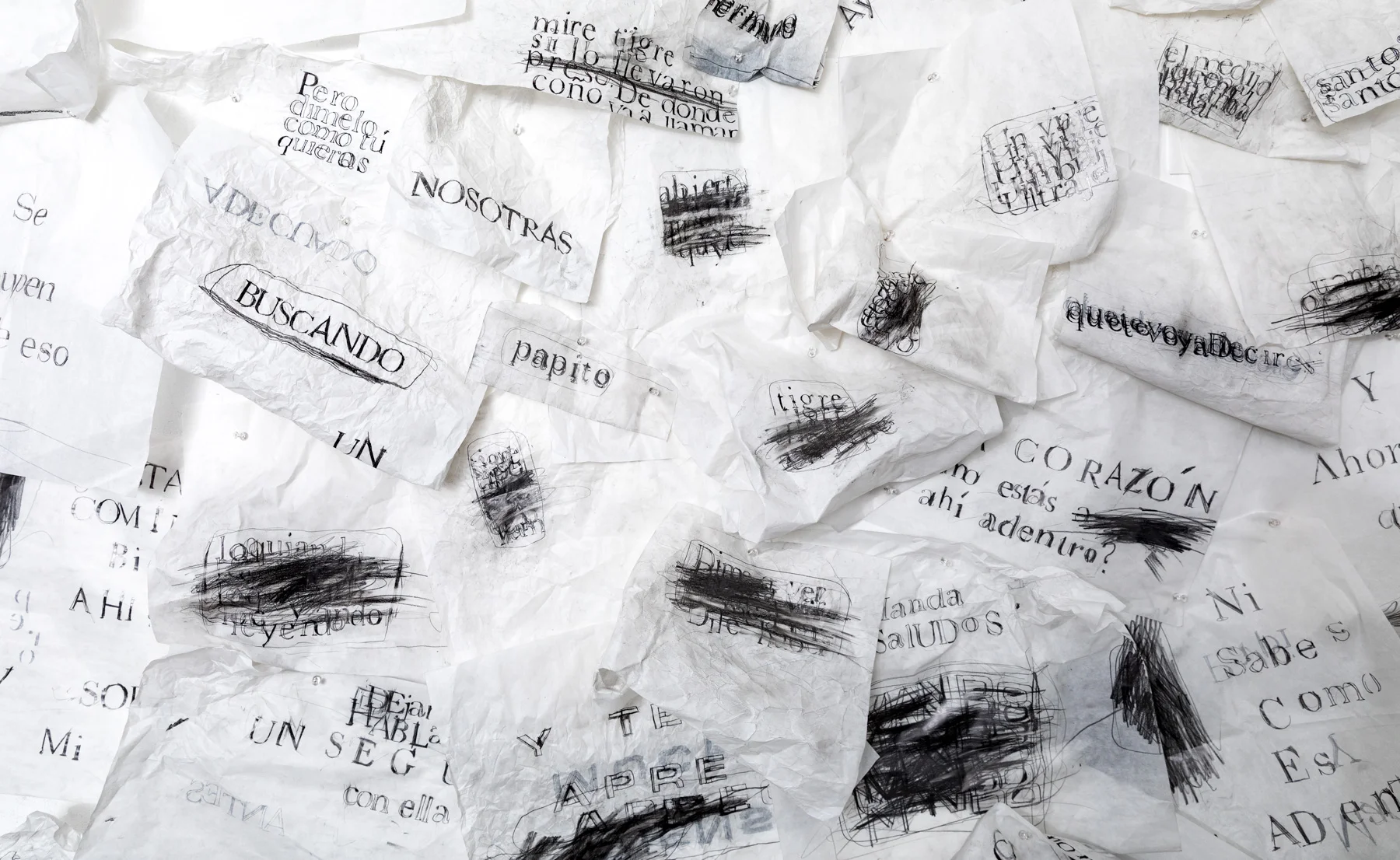
These drawings are based on affidavits prepared by police officers in order to obtain search warrants. These lengthy, often repetitive and recycled documents are submitted to a judge for approval so that a police department can legally search a person or premises. The layered, illegible texts in the drawings point to the duality of the language in those documents: essential but evocative of a rinse and repeat process.
2017, Single channel video, 00:02:54
The speakers in Practically Inevitable are court interpreters in the Boston area incanting the deportation warning contained in the Defendant's Waiver of Rights, a form signed whenever a defendant pleads guilty to a crime.
These works include fragments from judicial proceedings that I have either observed or participated in as a court interpreter. The slow, mechanical, inflexible nature of the typewriter references the character of the court system.
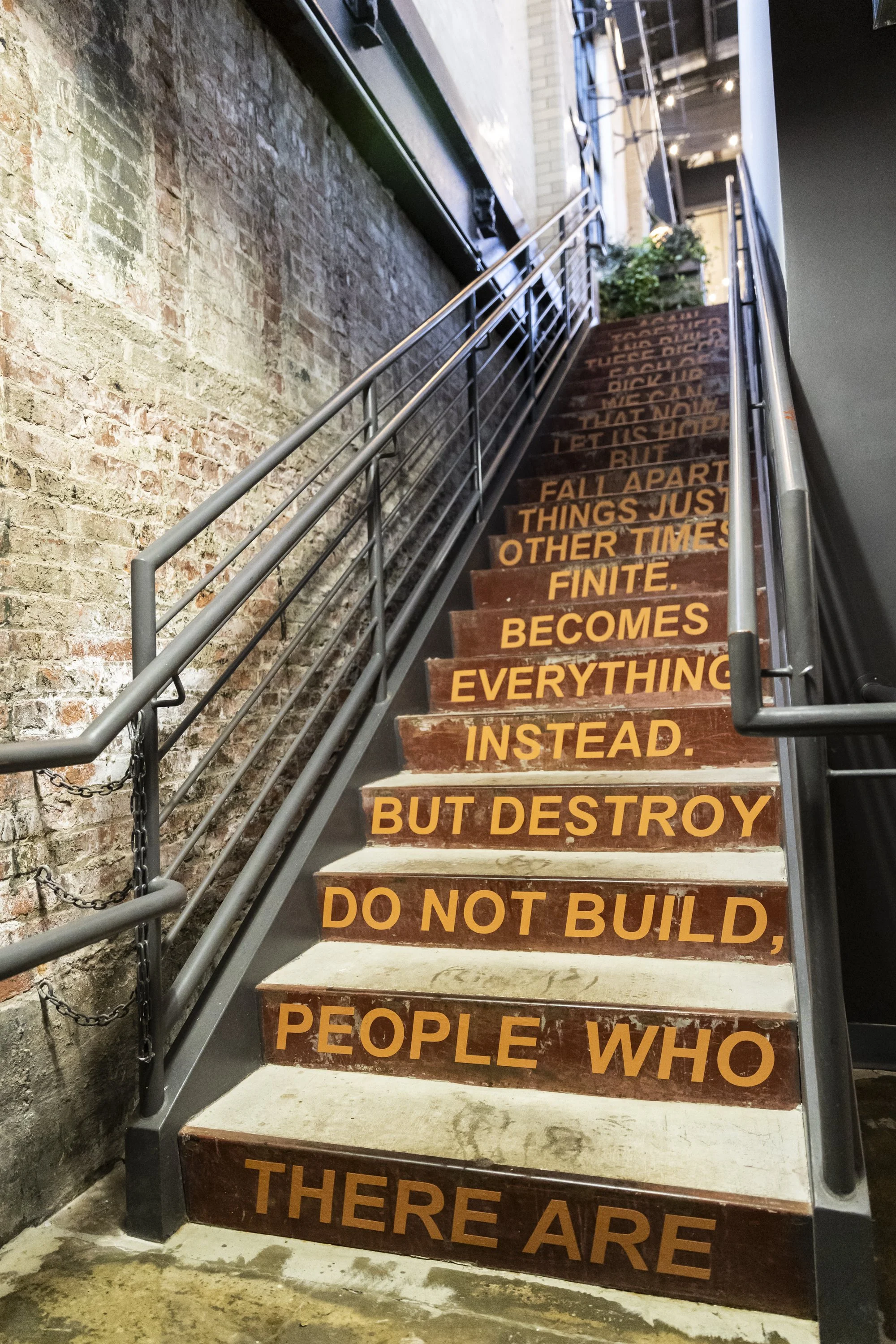
In this site-specific work, the revival of the substation—which until the 1970s powered Boston’s trolley system—serves as a point of departure to consider questions about togetherness, community relationships, and moving forward in the face of uncertainty. The text was inspired by transcribed interviews with Roslindale residents in the 1970s, particularly the words of Louise Goodsill, whose oral history is part of the archives of the City of Boston and the Roslindale Historical Society.
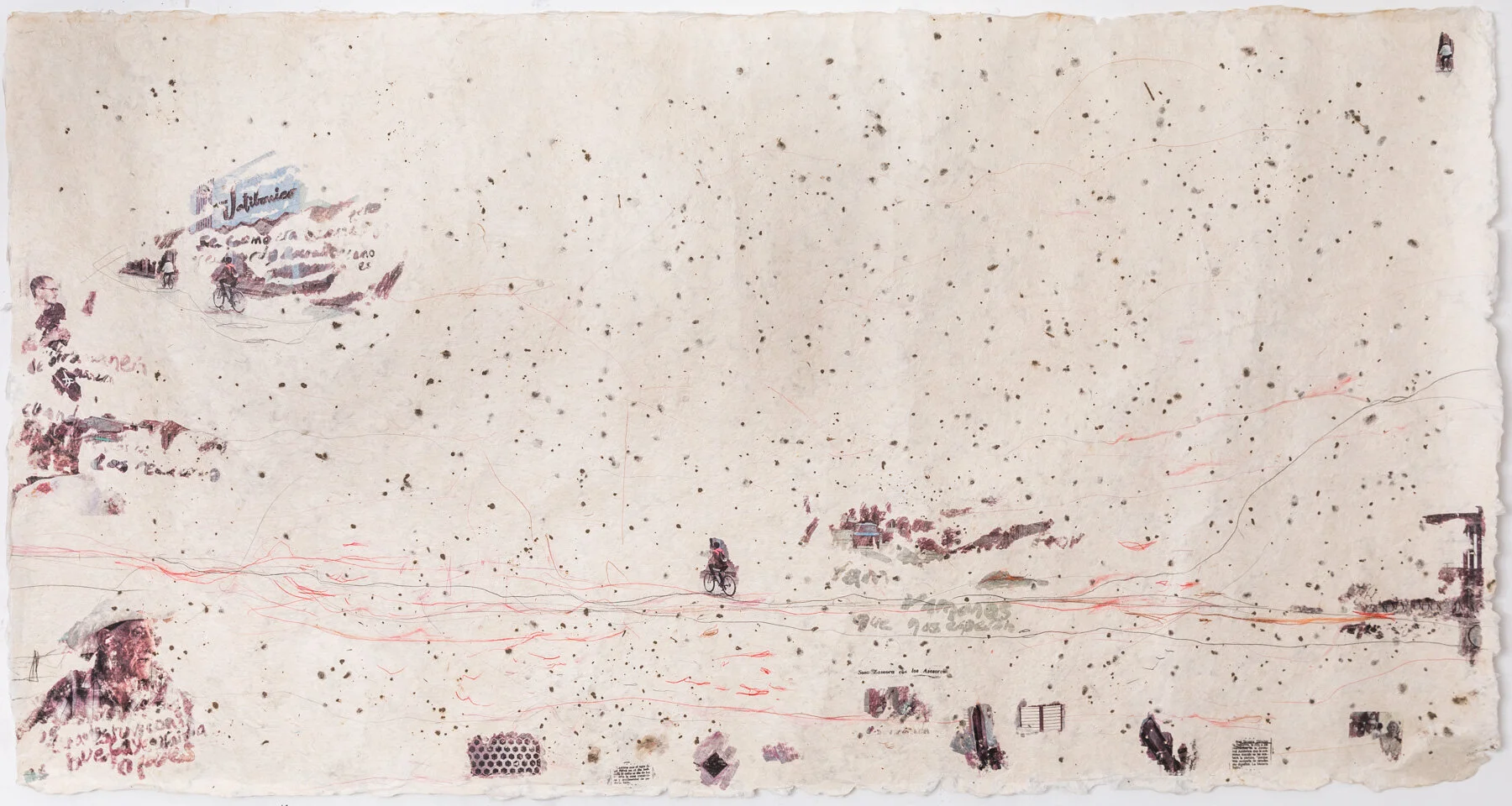
A Message to Deliver Cuba Gabriel Sosa
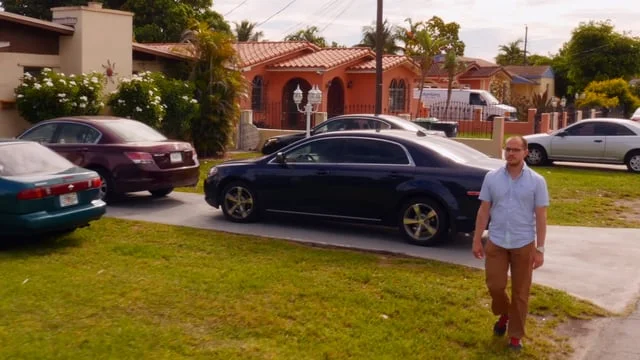
23 Years Later recreates a walk the artist as a child would take with his grandfather in the early 1990s. On Saturday mornings, they would go on what at the time seemed like a lengthy trek from their home to La Campana, a local convenience store which served as a hub for an older generation of Cuban men to smoke cigars and talk politics. Today, both La Campana and the artist's grandfather are long gone. His family has also moved from the house in Miami where he was raised. Taking Cues from the work of Dara Friedman and Francis Alys, 23 Years Later considers the resilience of memory and how we confront the passage of time.